Card Capture: The Little Solitaire That Reinvented Deck Building
There's something quietly magical about a card game that needs no fancy components, no rulebook the size of a novella, and no trip to a game store. Just a standard deck of 52 cards — the one gathering dust in your kitchen drawer — and a surprisingly clever set of ideas. That's Card Capture in a nutshell: a solitaire game that smuggles full deck-building strategy into a format so accessible it almost feels like cheating.
But don't let its humble presentation fool you. Card Capture earned its reputation as an outstanding solitaire game.
And when you're ready to play, we've put together our own pulp sci-fi Martian Invasion version right here. It's the same great rule set — we didn't want to mess with the original systems of the game. Given how nicely this game lends itself to a story, we decided to have a little fun with the theming.
Origins: Born in a Contest
Card Capture was designed by Lucas Gentry and entered into the 2018 Solitaire Print and Play (PnP) Contest hosted on BoardGameGeek — an annual community event where solo game designers compete to create the best no-frills solitaire experiences. The contest is famously unforgiving: entries are judged on elegance, replayability, and how well they actually work as games, not just as rule sets.
Card Capture was a hit at the 2018 contest, winning Best Card Game Using a Traditional Deck of Playing Cards. It's a significant accomplishment in a field where most entries are built around custom-printed components. Gentry's achievement was designing something that could be played by anyone, anywhere, with a deck they almost certainly already owned. BGG members have since expanded this idea into a standalone Traditional Deck Game Design Contest that has been an annual event since 2021.
The game originally had no theming, but that was fixed shortly after its creation with an optional illustrated version featuring a robot rebellion theme — thematic art available on BGG that reimagines the suit cards as factions of machines rising up against their human controllers. It's a fun aesthetic layer that doesn't change a single rule, but it gives the game a memorable identity if you want something more evocative on the table.
The Central Idea: Solitaire Meets Deck Building
To understand what makes Card Capture tick, you first need to appreciate what it's blending together.
Traditional solitaire is a patience game — you manipulate a layout of cards according to fixed rules and hope the arrangement cooperates. There's strategy, sure, but it's largely about reading the board and making the best of what the shuffle gave you.
Deck building (as popularized by games like Dominion) flips that: you start with a weak hand of cards and gradually acquire better cards over the course of play, crafting a custom deck that grows more powerful over time.
Card Capture marries these two ideas using nothing but a standard deck. You start weak, you get stronger, and you're fighting against the deck itself. The enemy isn't another player — it's entropy, probability, and the inexorable march of cards you can't afford to let slip past you.
Setup: Two Decks in One
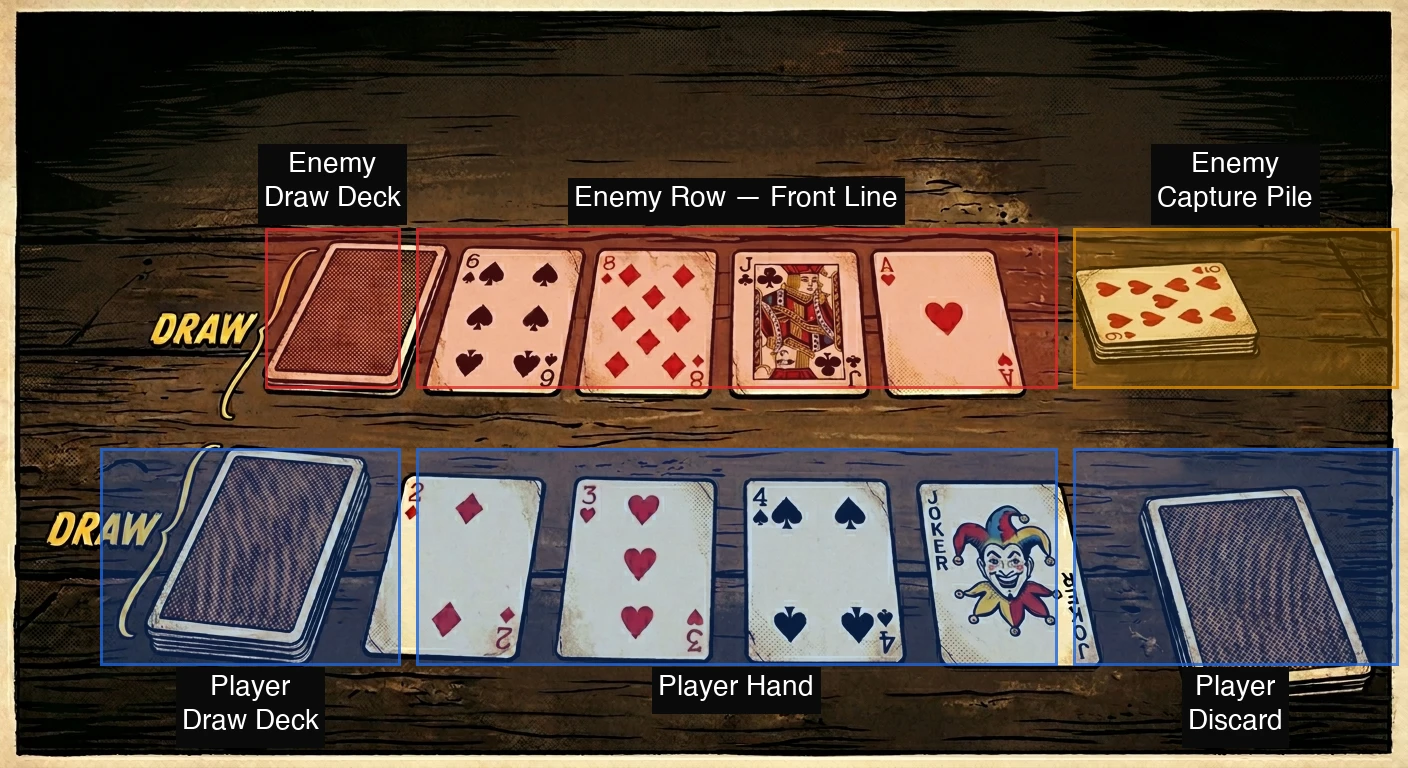
The setup is deceptively elegant. Before you play, you split the deck into two distinct piles:
- Your Personal Draw Deck: All the 2s, 3s, and 4s from every suit, plus both Jokers (if your deck has them). These small-value cards are your weapons — humble but yours.
- The Enemy Draw Deck: Everything else. The 5s through 10s, and crucially, the face cards (Jacks, Queens, Kings) and Aces. These are the enemy combatants you'll need to defeat.
The Enemy Draw Deck is shuffled and placed on the left side of your play area. Four enemy cards are drawn face-up to form the Enemy Row — your active battlefield.
You start with a hand of four cards drawn from your Personal Deck. And then the fight begins.
How Play Works: The Capture Phase
Each round follows a clear rhythm:
-
Refresh the Enemy Row: Any enemy cards that weren't captured shift to the right. The leftmost position is refilled from the Enemy Draw Deck. This matters — cards that linger in the row for too long become increasingly dangerous.
-
Discard and Draw: You discard any cards you don't want from your hand, then draw back up to four cards from your Personal Deck. This is where early deck-building instinct kicks in — what you keep, what you discard, and in what order you cycle through your deck shapes everything.
-
Capture: To take an enemy card off the board, you must spend cards from your hand that match the same suit as the target card and whose combined value is equal to or greater than the enemy card's value. Those spent cards go to a discard pile — they leave your hand, but they're not gone forever; they'll cycle back through your deck.
The face card values are fixed: Jacks are worth 11, Queens 12, Kings 13, and Aces a fearsome 14. A lone 2, 3, or 4 isn't going to capture an Ace by itself — you'll need to combine cards strategically and hope the suits line up.
The Joker: Your Wild Card
Both Jokers live in your Personal Deck and serve as wild cards — but within limits. A Joker mimics any other card you play alongside it, copying that card's suit and value. Play two Jokers in the same attack and each one independently mimics a card — so a 4♥ played with two Jokers counts as three 4♥s, for a total of 12. Powerful, but the Joker can only mimic cards already in your deck (2s, 3s, and 4s), so it won't help you punch above your weight class against a King or Ace on its own.
Using Jokers wisely is one of the skill gaps that separates a good Card Capture player from a great one.
Tactical Retreat: Letting the Enemy Win One
Sometimes capture isn't possible and you'd rather cut your losses than burn resources on a bad hand. In that case you can let the enemy take one of your cards. The rightmost enemy card in the row seizes a card of your choice from your hand — both are removed from play and placed in the Enemy Capture Pile, gone for good.
It sounds grim, but it has a tactical upside: it's the only way to permanently purge a card from your deck. If you've accumulated high-value face cards and Aces through earlier captures, and one of them is sitting in your hand with no good play, surrendering a low-value number card alongside the enemy clears the enemy row position without costing you anything you'll miss.
The critical caveat: if any Ace, Jack, Queen, or King — yours or theirs — ever lands in the Enemy Capture Pile, the game ends immediately in defeat. So a tactical retreat is only truly safe when the card you're sacrificing is a humble 2, 3, 4, or 5-through-10. Never let a commander near that pile.
The Sacrifice: A Safety Valve with Teeth
Sometimes the board is just bad. An enemy card is sitting in a dangerous position, you can't capture it this turn, and letting it stay means risking more cards piling up. That's where the Sacrifice mechanic comes in.
By discarding any two cards from your hand — voluntarily, as a tactical choice — you can move one enemy card from the row to the bottom of the Enemy Draw Deck. You're buying time, essentially, at a real cost.
The catch: you cannot sacrifice an Ace, Jack, Queen, or King from your own hand. Playing one of those cards as a sacrifice moves the face card or ace to the enemy's capture pile, and the game ends immediately. The face cards and Aces in your personal deck (yes, they can end up there via capture mechanics) are both your most powerful tools and your greatest vulnerability.
Win, Lose, and the Loop of Tension
You win Card Capture by clearing all enemy cards — every single card from the Enemy Draw Deck and the Enemy Row ends up in your Capture Pile. It's a satisfying endpoint that feels genuinely earned.
You lose if an Ace, Jack, Queen, or King from your personal deck ever gets captured by the enemy — which can happen when your card gets taken during a failed capture attempt. The asymmetry here is brilliant: the same face cards that make you powerful are the ones that will cost you the game if mishandled.
This creates a wonderful loop of tension. The early game is cautious and methodical — you're working with small cards and trying to establish momentum. The mid-game opens up as you start incorporating captured enemy cards into your strategy. And the late game becomes a nail-biting race to clear the remaining threats before your luck runs out or your deck gets picked apart.
What Makes It Special
Card Capture succeeds because it doesn't try to be everything. It identifies one interesting design space — deck building through a solitaire lens — and commits to it with minimal rules overhead.
The suit-matching requirement is the key constraint that makes the game interesting rather than trivial. If you could spend any cards to capture any enemy, the game would reduce to simple arithmetic. The suit requirement forces you to pay attention to the composition of your hand and your deck simultaneously, creating genuine decisions every turn.
The progressive difficulty of the enemy cards also mirrors the traditional deck-building arc beautifully. Early enemies (the 5s and 6s) are manageable. Mid-range enemies (7s through 10s) require planning. Face cards and Aces demand coordination across multiple turns. This natural escalation gives the game a narrative shape even without any story mechanics.
And then there's the sheer accessibility factor. Card Capture requires nothing you don't already have. No printing, no crafting, no shopping. This design constraint almost certainly shaped the game's rules — Gentry couldn't rely on custom components to carry any weight, so every mechanic had to earn its place within the vocabulary of a standard deck.
Legacy and Digital Life
Since its 2018 debut, Card Capture has built a devoted following in the solo gaming community. The BGG forum for the game offers up discussion, variants, thematic re-skins (an Advance Wars re-theme has earned particular praise), and proposed expansions including a Legacy mode that adds a persistent progression layer between sessions.
It's the kind of game that rewards being played. Each session teaches you something new about deck composition, about when to sacrifice and when to push, about the geometry of suits and values. And when you finally clear that last enemy card after a close-fought session — trust us — it feels great.
How to Get Started
All you need is a standard deck of cards (with Jokers). The full rules are freely available on BoardGameGeek. If you want the illustrated robot-rebellion version with themed card art, those printable files are also hosted on BGG for free.
Pull out the 2s, 3s, 4s, and Jokers. Shuffle up the rest. Draw your first hand. And get ready to wage a very small, very satisfying war.
Or if you want to play right now in your browser, our Martian Invasion version is waiting for you with the same great ruleset, just with a fun pulp sci-fi theme.
Looking for more solo card adventures? If dungeon crawling is your thing, Clear the Dungeon is another excellent standard-deck solitaire — twelve monster face cards dealt into a four-column dungeon, defeated one suit-matched trigger at a time. Read our full guide to how it plays and see whether the dungeon can be cleared. And if you want to trace the origins of the dungeon-crawler-in-a-deck format, our Scoundrel history and how-to covers the 2011 design that started it all.